
There's a White Ring on My Antique Table. Can It Come Out Without Refinishing?
Last updated
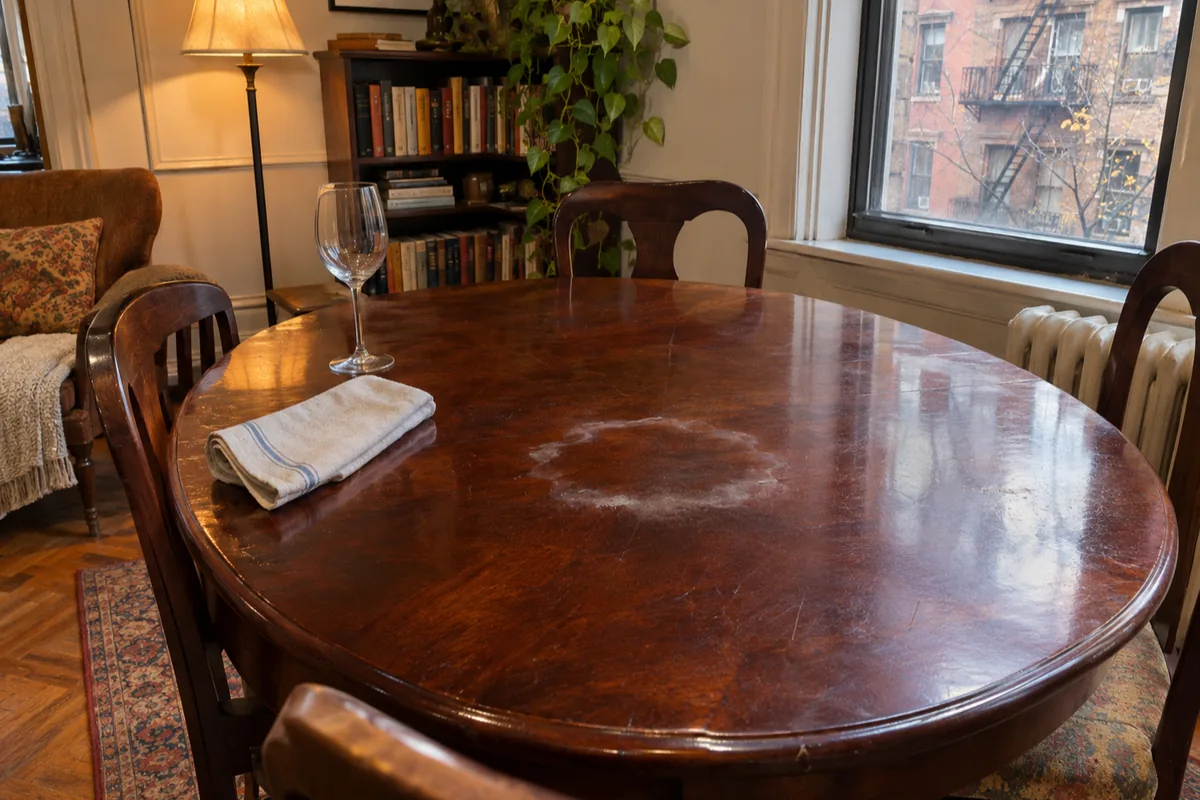
The guests have gone, the dishes are cleared, and you pull the tablecloth off your grandmother's dining table. There's a foggy white ring where the gravy boat sat, maybe two, and a cloudy patch where somebody set down a hot casserole on a folded towel. The table was fine at dinner, and now it looks ruined.
It probably isn't. A white mark looks a lot worse than it is, and most of them come out with patience and very little else.
White Rings and Dark Rings Are Two Different Problems
There's a white ring on my antique table. Can it come out without refinishing?
Usually, yes. A white ring is moisture trapped in the finish while the wood underneath is usually fine, so it can often be lifted with gentle, dry heat and nothing has to be stripped. A dark or black ring is a different job, because it means the water got through the finish and into the wood, and that one needs the top stripped and refinished.
Why the Ring Turned White in the First Place
A hot dish or a sweating glass pushes a little moisture into the finish, and when the surface cools that moisture gets shut inside it. The trapped water scatters light, which is why the mark reads as white or milky instead of wet. If the stain is white, that's a good sign, because it means the trouble is sitting in the finish and hasn't reached the wood.
Antiques get these more than newer furniture does. Most tables made before the twentieth century were finished in shellac, and shellac is lovely to look at but softens with heat and clouds up with moisture far more easily than a modern varnish. A Thanksgiving table with a dozen hot plates on it is close to the worst evening a shellac top can have.
New York adds its own reasons. Heat season runs from October through May, so for eight months a lot of dining tables sit a few feet from a radiator, and the finish is already drier and more tender than it would be in a house with forced air. Heat rings from radiators, water from a leak in the apartment upstairs, and sun fading from a south-facing window are the three finish problems we see most in the city, and all three can be fixed.
A dark ring is the one to look at carefully. Gray, brown or black means the water went through the finish and stained the wood fibers, the way a coffee spill marks raw pine. Heat can't draw that out, because there's nothing trapped in the finish to draw.
What You Can Try at Home This Week
Give it a day or two before doing anything. Some faint white marks fade on their own as the moisture works its way out, especially in a heated apartment where the air is dry.
If it's still there, try dry heat. Lay a clean, dry cotton cloth over the ring, like a plain white T-shirt or a tea towel, and press it with an iron set low with the steam turned off. Keep the iron moving in short passes of a few seconds, then lift the cloth and look. You're trying to warm the finish just enough to let the moisture out, and it often takes several rounds. A hair dryer on low, held a few inches away and kept moving, does the same thing more slowly.
There are a few things to skip. Don't use steam, which is the thing that caused the problem. Don't rub it with denatured alcohol either, because alcohol dissolves shellac, and on an older table that's how a white ring turns into a dull, soft patch that needs a proper repair. If you're not sure what finish you have, the cotton swab test in what antique refinishing involves takes a minute and tells you. And go easy on old remedies like mayonnaise mixed with ashes, since anything gritty rubbed into a soft finish leaves fine scratches behind.
Try whatever you're going to try on the edge of the ring first, not the middle, so if the finish reacts badly you've only marked a small spot.
When to Stop and Let Someone Look at It
Stop if the ring gets darker instead of lighter, if the finish starts to feel tacky or soft under the cloth, or if you see small bubbles or a crackled texture where the iron was. Those mean the finish is giving out under the heat, and more heat only makes it worse. Stop too if the ring sits on veneer that's lifting at the edges, since heat can loosen old glue as easily as it lifts moisture.
That's the point to send a photo. Take one of the whole top, then a close shot of the ring under a lamp held low and to the side, which shows whether the mark is in the finish or under it. From that we can usually tell you whether the top can be revived in place or needs a full strip, and on an antique the difference matters, because the original surface is a big part of what the piece is worth. It's the same reasoning behind how we approach antique furniture restoration: keep the original wherever it can be kept.
What We Do With a Ring That Won't Come Out
Marcos and the team start with the gentlest thing that works. A stubborn white ring in a sound shellac finish can often be lifted and the area blended back in, and that's a much smaller job than a refinish. We don't strip a finish that only needs cleaning and a little repair, and the written quote says which one your table needs before anything is touched.
When the water has gone into the wood, the top has to come back to bare wood. We strip it by hand with chemical strippers, and a belt sander never goes near veneer, since an antique veneer is thin and a sander goes through it before you can lift the tool. The stained area is bleached where it needs it, the stain is matched to a sample you approve, and the finish goes back on in coats: shellac again on a piece that was shellacked, with French polish where the table calls for it. If something else turns up once the old finish is off, you hear about it and approve the price before any extra work is done.
Pickup and delivery are available across the five boroughs, with the charge for it on the written quote. If the ring came with scuffs and gouges after a move, read what to do with an antique after a move before touching anything, and for a newer table with the same marks our furniture restoration work covers it.
Keeping the Next Ring Off the Table
The cheapest fix is a trivet. Put one under anything that came out of the oven, and use coasters even for a glass of water, because a cold drink sweating onto shellac does the same thing as a hot dish in slower motion. For a big holiday dinner, a felt table pad under the cloth takes most of the heat and spills before they reach the wood.
In a small apartment the dining table is often the desk too, so the morning coffee mug is as much of a risk as the turkey. And if the table sits near a radiator, moving it even a couple of feet away for the heating season keeps the finish from drying out and makes it far less likely to cloud the next time something warm lands on it.
Try the dry iron first, and if the mark won't move or it looks darker than white, send us photos. We'll tell you whether it's a small repair or a refinish, and if a ring that faint is better left to fade, you'll hear that too. Quotes from photos are free. Call or text (914) 449-4334, or see how we handle antique furniture restoration in New York.